How can data and maps help communities work towards memory justice in the built environment?
Audit the Streets is an early-stage project about auditing the U.S. heritage landscape–its collection of commemorative street names, places and monuments.
The murder of George Floyd on May 25, 2020 in Minneapolis, MN, led to sustained protests, rallies, and public outcry against systemic racism. People turned out in public spaces, and they also took action to contest and transform those public spaces both literally and symbolically: Muriel Bowser, the mayor of Washington D.C. renamed a two-block street section in front of the White House to “Black Lives Matter Plaza.” A statue of Christopher Columbus in Boston was beheaded and another in Baltimore was hurled into a river.

What these recent flash points have in common is that they are using the heritage landscape of the city as a site of contestation.
Through our own mixed-methods research as well as a public data portal that we have built, we introduce the idea of auditing the heritage landscape–creating databases, lists, and visualizations (see previous page) which highlight and quantify unequal public memory as well as the persistent elevation of perpetrators of violence in the landscape.
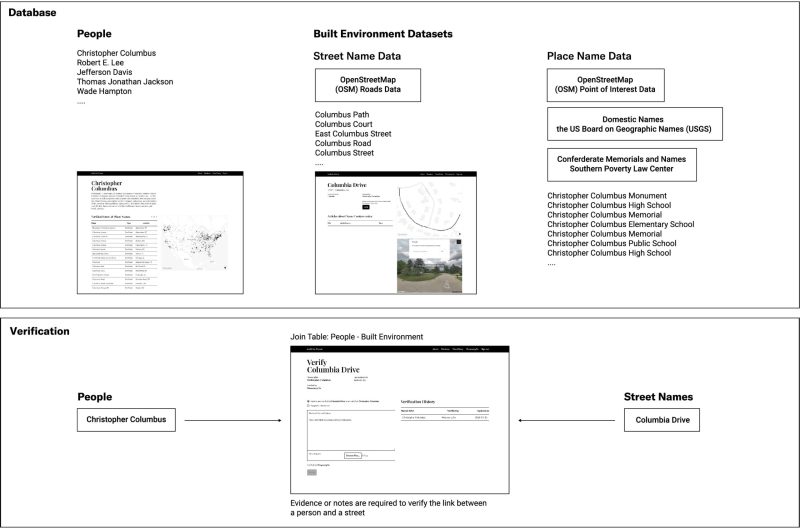
The Audit the Streets architecture integrates Place Name and Persondata from a variety of sources, including OpenStreetMap, the USGS geographic name data, Wikipedia, and others. Once Place Name and Person data is imported into the system, it goes through a semi-automated verification process to create thelink between people and places.